Every Collection Has a Personality
Arkiv described my ~800-title shelf back to me with startling precision. Turns out a ten-movie shelf can be just as legible, maybe even more so.
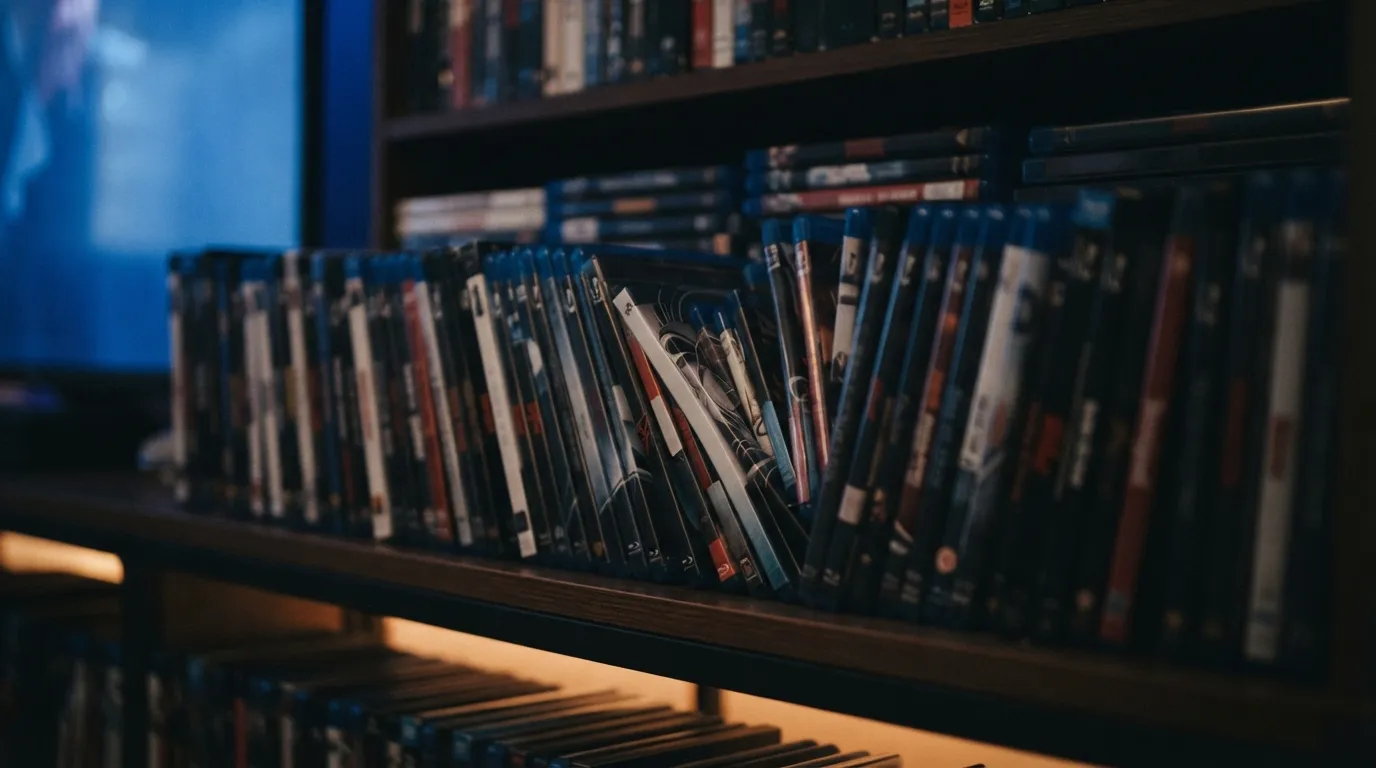
I've had over eight hundred discs for a while now, and I still catalog every one myself, so I thought I knew exactly what I owned. Then Arkiv generated a portrait of my own shelf and told me something I hadn't put into words:
"Nearly half the collection arrived in the 2010s, which tells you this shelf cares about contemporary cinema and follows its evolution frame by frame. Action, Adventure, and Drama compete for the top spot because the best films here refuse to choose between them: Villeneuve building dread at scale, Fincher assembling precision, Scorsese turning violence into moral inquiry. Spielberg leads your directors by a clear margin, but you've also got Scott, Bay, Zemeckis, and Liman alongside him, which means you're watching for different reasons: sometimes for wonder, sometimes for craft, sometimes for the sheer architectural ambition of getting a vision that large onto a screen. Over 800 copies in Blu-ray, and you're still reaching for newer work. This is active collecting, not archiving."
I read that twice. Then I went and checked my own shelf against it, half expecting to catch it guessing. It wasn't guessing. Spielberg does lead by a clear margin. I do reach for the big, ambitious, contemporary stuff more than I reach for anything else. I've never described my own taste that specifically to another person, and a piece of software just did it to me, unprompted, from nothing but a list of titles and purchase dates.
It's a strange thing to have your own taste explained back to you more clearly than you'd explained it to yourself.
Here's the part I keep turning over, and it's not really about size the way I first assumed. My eight hundred titles have a personality because of volume: a pattern repeats often enough that it stops being coincidence. Spielberg keeps showing up. The 2010s keep showing up. Eventually that's just who I am as a collector, and there's enough data for a portrait to say so with confidence.
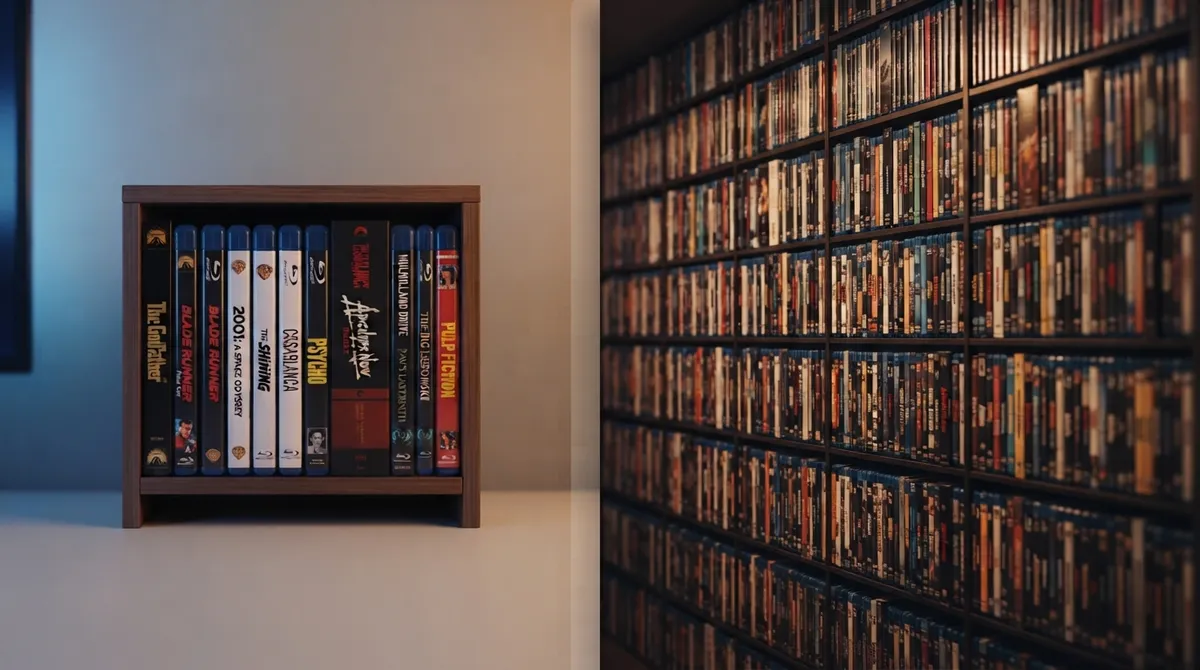
But a ten-movie shelf isn't a personality-in-waiting, some rough draft waiting to accumulate enough titles to count. It might be the opposite: a personality with nowhere to hide. If every disc on that shelf was a deliberate choice, no impulse buys, no mismatched gifts, nothing you regret, the portrait doesn't need eight hundred data points to be accurate. It needs ten honest ones. A small, curated shelf can be more legible than a sprawling one, not less, because there's no noise to average out. Different sizes just produce different kinds of signal. Mine reads as a pattern across volume. A tighter shelf reads as a set of clear, deliberate choices. Neither is a rough draft of the other, and neither is more "real" collecting than the other.
I see the same thing in how people actually use Arkiv. Some new signups add one movie and leave it there for a while. Others show up on day one with a CSV of nine hundred titles they've been tracking in a spreadsheet for a decade. It would be easy to read that as serious collectors versus everyone else, but that's not really what's happening. What counts as a big collection to one person is barely getting started to another, and the reverse is just as true. The one-movie shelf might belong to someone who started last week and is exactly where they should be. The nine-hundred-title import might belong to someone finally catching a decades-old habit up to the present, not someone who cares more than the person who added one title yesterday. Everyone's on their own timeline. What a shelf's size actually tells you is how long someone's been at it, or how they chose to start, not how much the collection means to them.
Which is also what makes one honest caveat worth saying out loud, whatever size the shelf is: the portrait describes what I buy, not everything I love. I watch plenty of small, strange, quiet films, the kind that show up at a festival, get a two-week theatrical run, and vanish. I love those. I just don't reliably buy them. They live in my Letterboxd history and my memory, not on my shelf, because owning a physical copy of a film I watched once in a nearly empty theater has never felt like the point to me the way owning Dune or Fincher's filmography does. Arkiv can only read the shelf. It has no way of knowing about a movie I loved and never bought, because from the outside, that movie and a movie I've simply never seen look identical: absent. That's not a gap in what Arkiv built, it's just what happens when you read taste through ownership. Ownership is a real signal, at any collection size. It was never trying to be the only one.
What I'm actually curious about now runs in both directions. I personally know a few collectors sitting on three, four, five thousand titles, none of whom are on Arkiv yet (something I should probably fix), and I genuinely don't know if a personality stays sharp at that scale or starts to read more like a library card catalog than a self-portrait. And I'm just as curious about the other end: someone ten titles into their collection, right at the floor where a portrait starts to generate, where every choice is visible and nothing gets buried in volume. That portrait might turn out to be the most pointed one Arkiv ever generates. If you've got either kind of shelf, small and deliberate or large and sprawling, I'd like to know what your portrait says.
Arkiv builds a picture like this from your own shelf, no extra data entry required, whatever size it is right now, just the titles you already own. There are some fun things to uncover about your own taste as your collection grows, at any stage. Try it for your own shelf.
0 Comments
Sign in to join the discussion.