Do Blu-rays and DVDs Degrade Over Time? What Disc Rot Actually Is
I own The Matrix, Enemy of the State, and Bad Boys on DVDs I bought in the late 90s. They still play perfectly. So do discs actually rot? The honest answer: it depends which disc.
I still have my first-print DVDs of The Matrix, Enemy of the State, and Bad Boys. I bought all three in the late 90s, when a DVD felt like a small piece of the future and I was happy to pay full price to own one. They are getting close to thirty years old now. Last month I pulled The Matrix off the shelf, half expecting a problem, and it played start to finish without a single hiccup.
That surprised me more than it should have, because if you go looking online you will find headlines telling you your discs are quietly dying and have maybe ten years left. In 2026 that anxiety has extra fuel: physical media is genuinely harder to find, Best Buy has exited discs entirely, digital keeps eating the shelf space, and yet there is a real resurgence happening at the same time, with 4K UHD sales up and boutique labels selling out pre-orders. If you are going to keep buying discs, or you are sitting on a collection you have had for decades, it is fair to ask whether the thing you bought because it lasts is actually built to last.
Here are the real answers, sorted the way people actually ask them.
Do Blu-rays and DVDs degrade over time?
Pressed commercial discs, the ones you buy in a store, degrade very slowly and almost certainly not within your lifetime if you store them reasonably. Recordable discs, the blank DVD-Rs and BD-Rs you burn at home, are a different story and can fail in years rather than decades.
That single distinction, pressed versus burned, explains almost every contradictory thing you will read on this subject. My late-90s DVDs of The Matrix and Enemy of the State are pressed discs. That is why they still play. A wedding video someone burned to a blank disc in 2005 is a coin flip.
What is disc rot, exactly?
Disc rot is the deterioration of the thin reflective layer inside a disc, the metal surface the laser reads. When that layer oxidizes, corrodes, or separates from the plastic, the laser can no longer read the data underneath and the disc starts to fail. On some discs it shows up as a bronze or coppery discoloration, which is why collectors sometimes call it "bronzing."
It is worth being clear that this is a real phenomenon, not a myth. It is just far more selective than the headlines suggest. It tends to hit specific manufacturing batches, specific eras, and discs kept in bad conditions, rather than sweeping evenly through everything on your shelf.
How long will a disc actually last?
The Canadian Conservation Institute, which studies exactly this, puts commercially pressed DVDs and Blu-rays in the range of many decades under good storage, with archival estimates running past 50 to 100 years. Recordable media is rated far lower, often just 5 to 10 years for a burned Blu-ray-R, though a well-made disc kept cool and dark can beat that.
The range is wide because longevity is mostly about conditions, not the format itself. Heat, humidity, and sunlight are what age a disc. A pressed Blu-ray in a case on a shelf in a climate-controlled room is in the best case. A burned disc in a hot attic is in the worst case, and those two scenarios can differ by decades.
Where did the "discs die in 10 to 20 years" claim come from?
That figure is real, but it describes the worst case, and it usually applies to recordable media, not the pressed discs your movie collection is made of. It gets repeated as if it applies to everything, which is how a headline about aging burned discs turns into a collector panicking about a factory-pressed 4K UHD that will realistically outlive them.
So when you see "many discs will stop working in 10 to 20 years," read it as "some recordable discs, stored poorly, will." It is not a countdown clock on your shelf of studio releases.
Are my old DVDs or older discs at risk?
Some early discs are genuinely more vulnerable, mostly because of manufacturing rather than age alone. A handful of pressing plants in the late 80s and early 90s produced discs, including some early CDs and laserdiscs, that were prone to bronzing because of flaws in how they were sealed. Those are the famous horror stories. Manufacturing quality improved a lot after that, which is part of why my late-90s DVDs are fine and a 1989 CD from a bad batch might not be.
The bigger risk factor for any older disc is what it lived through. Discs stored in humid basements, hot garages, or direct sun age faster regardless of when they were made. If you inherited a collection that spent twenty years in a damp basement, that is worth spot-checking. A shelf kept indoors at room temperature is not.
How can I tell if a disc has rot?
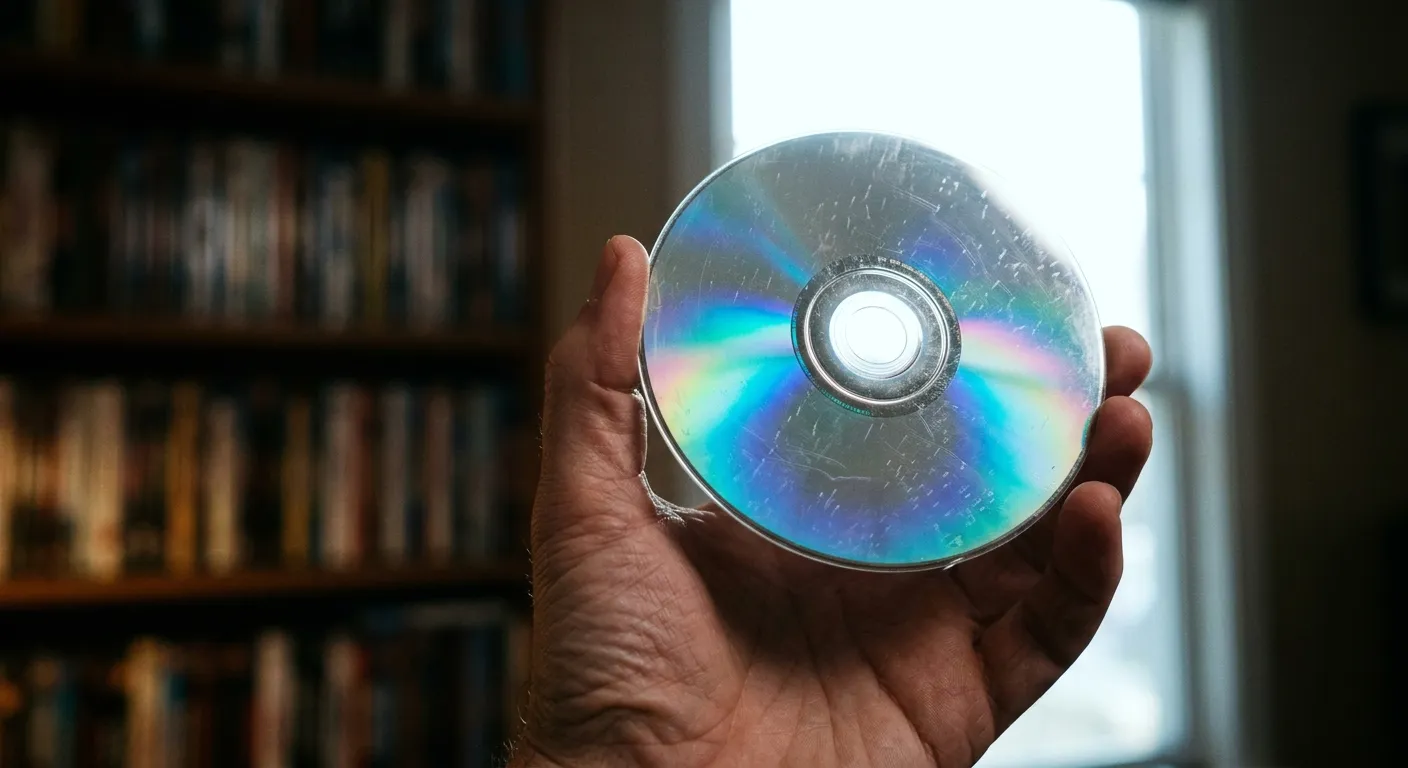
Hold the disc up to a bright light with the reading side facing the light. On a healthy disc the reflective layer is solid and even. If you see tiny pinholes of light coming through, cloudy patches, or bronze discoloration, the reflective layer is deteriorating. On playback, disc rot usually shows up as freezing, pixelation, or skipping that gets worse toward the outer edge of the disc, which holds the later part of the film.
The light test takes ten seconds per disc and is the fastest way to check the oldest or most humidity-exposed parts of a collection without playing every one.
How should I store discs to make them last?
Keep them cool, dry, and out of direct sunlight, and stand them vertically like books rather than stacking them flat. Heat and humidity are the main enemies, so an interior room beats an attic, garage, or basement. The original case does real work here, shielding the disc from light, dust, and handling.
None of this requires special equipment. If the room is comfortable for you to sit in year-round, it is comfortable for your discs.
Is VHS or tape different?
Yes, and worse. VHS is magnetic tape, and magnetic tape degrades faster and more actively than an optical disc, typically over a span of 10 to 30 years. It is vulnerable to a problem called sticky-shed syndrome, where the binder holding the magnetic layer breaks down and the tape becomes unplayable. If you have tapes with anything on them you care about, they are a higher preservation priority than any of your discs, and getting them digitized is the realistic long-term move.
So what should I actually do about it?
For most collections the honest answer is: not much, beyond storing things sensibly and not panicking. Your pressed movie discs are one of the most durable consumer formats ever made. The practical version of caring for a collection is knowing what is in it, keeping it somewhere reasonable, spot-checking the oldest or most humidity-exposed discs with the light test, and only bothering to re-buy or back up the genuine at-risk cases, which for most people means old burned discs and aging tapes, not studio Blu-rays.
The one thing that quietly matters most is the first one: knowing what you actually own. You cannot check on your oldest discs, or notice that the three you bought in 1998 are the ones worth a second look, if you have no record of what is on your shelves in the first place.
Arkiv is a platform for cataloguing your physical media collection, across Blu-ray, 4K UHD, DVD, and VHS. Knowing what you own, and how long you have owned it, is the first step to keeping it, and there are a few genuinely fun things to uncover as your collection grows.
Already cataloguing in CLZ Movies? Here's how that move looks, or an honest comparison if you're still deciding
0 Comments
Sign in to join the discussion.